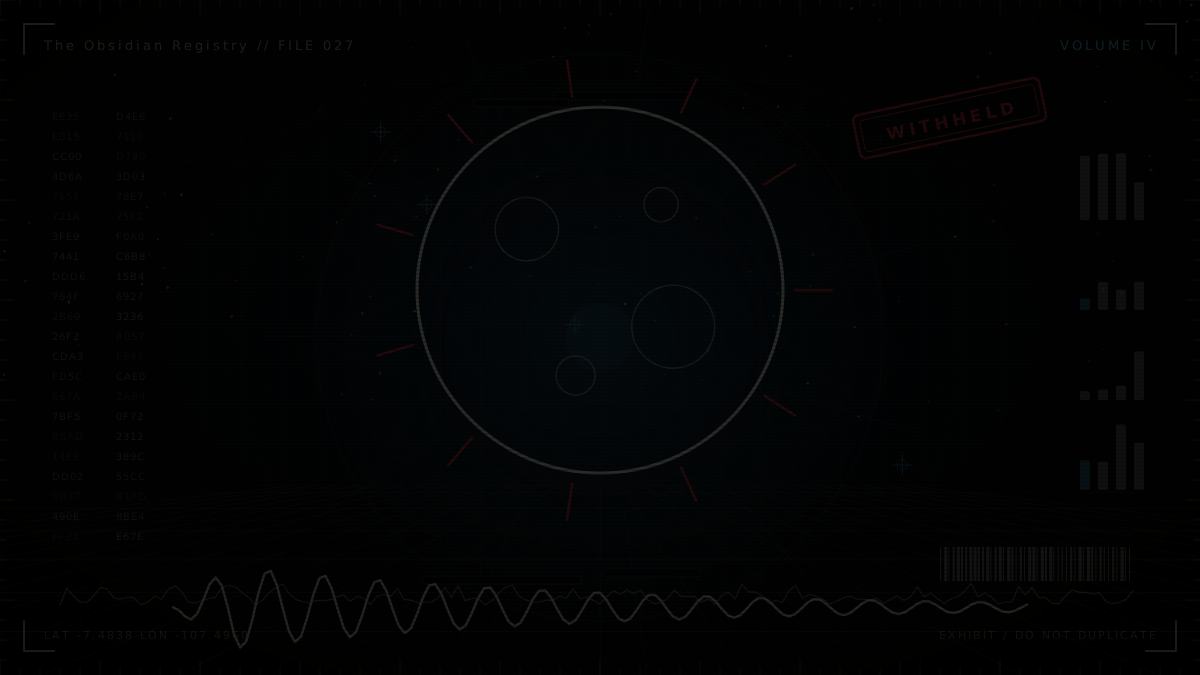
The Obsidian Registry · File 027 · FREE
NASA Erased the Original Moon Landing Tapes. One Man Kept a Reel.
In 1977, they turned off every ear we had on the moon. Ask yourself why.
Built on the real record of The Erased Apollo 11 Moon Landing Tapes. Every documented fact is numbered and cited at the end. The rest, use your own judgment.
logged · file_027.txt · 10.4 KB · recovered by
Intake record
| Recovered from | Hospice room, Clear Lake, Texas; a single reel of one-inch magnetic tape in a cookie tin |
|---|---|
| Contents | Data reel labeled PSE 12 / NOV 69 / KEEP, a printout of a sonification, a nurse's notes |
| Finder | N. Brenner, hospice nurse and granddaughter of the patient |
| Status | The reel has been digitized. The digital copy has been corrupted three times. |
On the night of July 20, 1969, roughly six hundred million people watched two men walk on the moon. What almost none of them knew was that a speech had already been written in case they never came home.
It is in the National Archives. It was drafted two days earlier by a White House speechwriter named William Safire, under the title In Event of Moon Disaster. "Fate has ordained," it begins, "that the men who went to the moon to explore in peace will stay on the moon to rest in peace." It instructs the President to call the astronauts' widows before reading it. It ends with a line that still makes people go quiet: "For every human being who looks up at the moon in the nights to come will know that there is some corner of another world that is forever mankind."1
The second thing almost nobody knows is that the original tapes of that night are gone.
The pictures you have seen are copies of a copy, a television broadcast filmed off a monitor. The original high-quality recordings, on reels of one-inch telemetry tape, were sent to storage, and then, during the tape shortages of the 1970s and 1980s, almost certainly erased and reused. NASA searched for them for three years. In 2009, it published its conclusion. The tapes had probably been wiped.2
Hal Brenner knew that, because he had wiped some of them himself.
Nell had been a hospice nurse for nine years. She had sat with hundreds of people at the end. She knew the stages: the restlessness, the reaching for people who were not in the room, the sudden desperate need to say something before the window closed. She had never had to do it for her own grandfather.
Hal was ninety-one. He had worked at NASA in Houston for thirty years, mostly in data. He had never talked much about it. He had talked about fishing, and the Astros, and his wife's peach cobbler, and he had kept a cookie tin on a shelf in his closet that Nell was not allowed to touch.
Three days before he died, he asked her to bring him the tin.
Inside was a single reel of magnetic tape. The label was typewritten. PSE 12. NOV 69. And beneath that, in Hal's handwriting, in pencil: KEEP.
"I was supposed to erase that one too," he said. "I couldn't do it."
He told it in pieces, over two days, between morphine doses.
PSE stood for Passive Seismic Experiment. When the astronauts of Apollo 12 left the moon in November 1969, they left a seismometer behind on the surface, to listen for moonquakes. Before they flew home, they did something nobody had done before. They sent the empty upper stage of their lunar module crashing back into the surface on purpose, at more than six thousand kilometers an hour, so the seismometer could record the impact.3
"We expected a thump," Hal said. "A few seconds. Maybe a minute."
The moon kept vibrating for more than fifty-five minutes. Even after an hour, the faintest reverberations had not died away. The scientists had never seen anything like it. The newspapers said the moon had rung like a bell.3
Nobody has ever fully agreed on why. The official explanation has to do with the dry, cracked rock of the lunar crust scattering the vibrations, and it is a good explanation. But in 1970, two scientists writing in a Soviet magazine called Sputnik had already gone further. They proposed that the moon was not a natural body at all. That it was hollow. A constructed thing, placed in orbit around the Earth, with a shell of armor beneath its dust.4
Hal shook his head when Nell said this. Not because it was wrong. Because it was not the strange part.
"The strange part," he said, "is what happened in December."
In December of 1969, the seismometer recorded the moon ringing again.
No impact. No meteor. No spacecraft. The moon simply rang, from inside, for fifty-five minutes, and then went still. Hal saw it on the printouts. He was twenty-four years old and he went to his supervisor with the paper shaking in his hands, and his supervisor looked at it for a long time, and then took it away.
It happened again in February. Then in May. Hal began to keep his own log. The ringing came irregularly at first. Then it began to fall into a pattern. Eleven strikes, each one a long, slow tolling, separated by silence. Then a gap. Then eleven more.
"Like knocking," Hal said. "Like somebody knocking on the inside of a door."
The men who came to see him in 1971 were polite. They wore suits, not uniforms. They told him the data was being consolidated. They told him there was a tape shortage. They told him he would be doing his country a service if he personally saw to it that the seismic reels from the period in question were recycled, and they told him that a man who could be trusted with a job like that would be the kind of man who got promoted. They told him about the pension.
He was twenty-six. He had a new wife and a baby on the way. He thought about the rule his supervisor had said to him, almost kindly, the day he took the printouts away.
WHAT ISN'T RECORDED DIDN'T HAPPEN.
He erased them. Every reel but one.
He was promoted twice that year.
The rest of the seismometers came later. Apollo 14. Apollo 15. Apollo 16. By 1972 there was a network of them, listening to the moon from four places at once, sending data home every day.5
On September 30, 1977, NASA switched them all off. The official reason was budget.5
Hal said he had been in the room. He said the ringing had been getting more frequent. He said the intervals between the sets of eleven had been getting shorter.
"They didn't turn them off because of money, Nellie," he said. "They turned them off because nobody wanted to hear it get to the end."
He died on a Thursday, at 3:11 in the morning, holding her hand. His last coherent sentence was about the peach cobbler.
Nell took the reel to a friend who restored old media for a university archive. It took him a month to build a machine that could read it. When he finally did, he converted the seismic data into sound, the way scientists sometimes do, speeding it up so that a human ear could hear it.
It was the moon, ringing. A deep, metallic tolling that made her friend's coffee mug vibrate on the desk. Eleven strikes. A gap. Eleven more. And at the end of the reel, Hal had spliced in a short length of tape from somewhere else, and on it, in a twenty-six-year-old voice she barely recognized, her grandfather was reading numbers.
The intervals. Measured to the second, set by set, across the whole of 1970 and 1971. And then, in his own careful arithmetic, a projection. If the intervals kept shrinking at the same rate, the gap between the sets would reach zero on a particular day.
She does not tell people the date. It is not far.
She did what Hal never did. She posted it. The audio, the printouts, the story. She thought it would change everything.
It got two hundred and eleven likes. A few people called it fake. A few people said NASA had explained the ringing decades ago. Most people did not watch to the end. A poll taken in 1999 found that six percent of Americans believe the moon landings never happened at all.6 The other ninety-four percent, she has realized, do not think about the moon at all.
There are still things on the moon that listen. The astronauts left mirrors there, panels of reflectors at three of the landing sites, and observatories on Earth still fire lasers at them and time the light's return, measuring the distance to the moon to within a few millimeters.7 Nell found a technician at one of those observatories who would talk to her, off the record.
He said the measurements have started doing something odd. He said that for the last year, the distance to the moon has been fluctuating by tiny amounts, in a rhythm. He said it was almost certainly instrument error.
He said the rhythm came in sets of eleven.
Sources
- 1William Safire's memo "In Event of Moon Disaster," dated July 18, 1969, contains a prepared presidential statement in case the Apollo 11 astronauts were stranded.U.S. National Archives, H. R. Haldeman files, Nixon Presidential Materials. Text reproduced by the National Archives at archives.gov.Find this cited reference ↗
- 2NASA concluded in 2009 that the original Apollo 11 slow-scan television tapes were most likely erased and reused during a magnetic tape shortage.NASA, "The Apollo 11 Telemetry Data Recordings: A Final Report" (Goddard Space Flight Center, 2009).Find this cited reference ↗
- 3The Apollo 12 lunar module ascent stage was deliberately crashed into the moon in November 1969. Seismic reverberations lasted more than 55 minutes."Apollo 12 Passive Seismic Experiment," Wikipedia, summarizing NASA mission records. https://en.wikipedia.org/wiki/Apollo_12_Passive_Seismic_ExperimentOpen cited URL ↗
- 4In 1970, Michael Vasin and Alexander Shcherbakov proposed in the Soviet magazine Sputnik that the moon might be an artificial, hollow body.M. Vasin and A. Shcherbakov, "Is the Moon the Creation of Alien Intelligence?" Sputnik (July 1970).Find this cited reference ↗
- 5Apollo missions 12, 14, 15, and 16 left seismometers on the moon. NASA switched off the network on September 30, 1977, citing budget.NASA Lunar and Planetary Institute, "Apollo Lunar Surface Experiments Package (ALSEP)" mission documentation.Find this cited reference ↗
- 6A 1999 Gallup poll found 6 percent of Americans believed the moon landing was staged.Gallup poll, July 1999.Find this cited reference ↗
- 7Retroreflectors left by Apollo 11, 14, and 15 are still used for lunar laser ranging, measuring the Earth-moon distance to within millimeters.NASA Goddard Space Flight Center, "Lunar Laser Ranging" program documentation.Find this cited reference ↗
Explore the underlying records
- NASA Apollo 11 mission overview
- Search nasa.gov for Apollo 11 original telemetry tapes NASA
- Search archives.gov for Apollo 11 original telemetry tapes NASA
Direct record links open named collections. Search links help locate related material; search results and cited titles are not individually authenticated here.
Archivist's note
The university technician who digitized the reel reports that each corrupted copy failed at the same point: the beginning of the final set of eleven.
The hospice nurse has asked that the projected date not be printed. The Archive has honored her request. It is not far.
That was the free one.
73 more files are waiting. They are not kinder.
Want the next one before anyone else?
The Archive opens on October 31. Join the priority list for 20% off.Leave your email and the Archive will warn you the moment a new file is unsealed.
No spam. We barely email. One click to leave.