
TRUE CRIME · CASE 57 OF 60 · LETTERS, NOTES & HEISTS · NO FICTION ON THIS PAGE
A Masked Man Hijacked Two Chicago TV Stations in One Night. Nobody Ever Found Him. The Max Headroom Incident.
The Max Headroom signal hijacking (Chicago, 1987)
Quick answer
Who hijacked Chicago TV as Max Headroom?
On the night of November 22, 1987, someone wearing a Max Headroom mask took over the broadcasts of two Chicago television stations. The first time, engineers cut him off in about 30 seconds. Two hours later he broke into a PBS broadcast of Doctor Who and stayed on the air for about a minute and a half. The FCC investigated. Nobody was ever identified, and the statute of limitations ran out in 1992.
Has the Max Headroom hijacking been solved?
Never identified. The statute of limitations expired in 1992.
When and where did the Max Headroom hijacking happen?
Sunday, November 22, 1987. Chicago. WGN-TV (channel 9) and WTTW (channel 11).
Inside this case (7 parts)
The Obsidian RegistryPublic recordCase 57
The Max Headroom signal hijacking
The Max Headroom signal hijacking (Chicago, 1987)
On Sunday night, November 22, 1987, people across Chicago were watching the WGN evening news.
The sports report was on. Then, at about 9:14 p.m., the screen went black.
When the picture came back, it wasn't the news. A figure in a rubber mask and sunglasses was swaying from side to side in front of a sheet of rippling metal, with a loud, buzzing hum.
It was the face of Max Headroom, a famous TV character of the time.
It wasn't him.
Who was Max Headroom?
In the 1980s, Max Headroom was a pop culture star. He was presented as a computer-generated TV host with a slicked-back hairstyle, sunglasses and a stutter, appearing in front of a background of moving lines.
In fact, he was played by an actor in makeup and prosthetics, because true computer graphics like that were not yet possible.
Max had his own TV shows and appeared in commercials for Coca-Cola. In 1987, almost everyone knew his face.
That is the face that appeared on Chicago television that night.
The first break-in
The figure on WGN never spoke. There was only the buzzing sound. The intrusion lasted about 30 seconds.
At the station, engineers realized what was happening. Someone was sending a stronger signal than the station's own to the transmitter on top of the John Hancock Center, which carried WGN's broadcast to viewers. The engineers changed the frequency of their link, and the pirate signal disappeared.
The news came back. The sports anchor, Dan Roan, looked into the camera and said that if anyone was wondering what had just happened, so was he. Then he went back to his report on the Chicago Bears.
The second break-in
About two hours later, at around 11:20 p.m., the public television station WTTW was showing an episode of the British science fiction series Doctor Who.
The picture was taken over again. The same figure appeared, in the same mask, in front of the same metal sheet.
This time there was sound. A distorted voice talked and laughed for more than a minute. The figure mocked a WGN sportscaster, made references to an old cartoon and to Max Headroom's Coca-Cola ads, and called WGN "the world's greatest newspaper nerds," a joke on the slogan of its parent company's newspaper.
The broadcast ended with a strange, crude scene of the figure being spanked with a flyswatter.
Then the signal cut out, and Doctor Who came back.
WTTW had no engineers on duty at its transmitter that night. Staff at the station watched the whole thing unable to stop it. The hijacker ended it himself. It had lasted about 90 seconds.
How it was done
Television stations at the time sent their programs from the studio to the transmitter on a tall building using a microwave link, a beam aimed from one dish to another.
Experts concluded that the hijackers aimed their own, stronger signal at the transmitter's receiving dish. When two signals arrive at the same receiver, the stronger one wins.
This took real technical knowledge and equipment. Experts also said the pirate transmitter likely had to be within line of sight of both towers, somewhere in or near downtown Chicago.
The rippling metal background was probably a sheet of corrugated metal, turning slowly, to imitate Max Headroom's moving background.
The investigation
The Federal Communications Commission opened an investigation. Officials said those responsible could face a large fine and up to a year in prison.
Investigators looked for anyone in Chicago with the skill and equipment to pull it off. Theories included a current or former station employee with a grudge, or someone from the city's community of radio and computer hobbyists.
Nobody was ever identified.
The five-year statute of limitations expired in 1992. Even if the people behind the mask came forward now, they could no longer be charged for it.
Nobody has ever credibly claimed responsibility.
Why it still matters
The Max Headroom incident is one of the most famous broadcast signal intrusions in history.
It became a kind of legend among hackers and fans of strange internet mysteries, partly because it is so odd. There was no political message. No demand. Just a mask, a buzz and a joke that nobody fully understood.
When the United States switched to digital television in 2009, this kind of hijacking became far harder to pull off.
What we still don't know
Who was wearing the mask, and who was helping?
Where was the transmitter, and where was the video recorded?
Why WGN and WTTW, and why that night?
And what was the point? Two hijacked broadcasts, about two minutes of television, and more than thirty-five years of silence.
Sources
Everything on this page comes from the public record above. Where sources disagree, we say so. People who were never charged are not named.
Read next · from the sealed Archive
If this case stays with you, open File 077
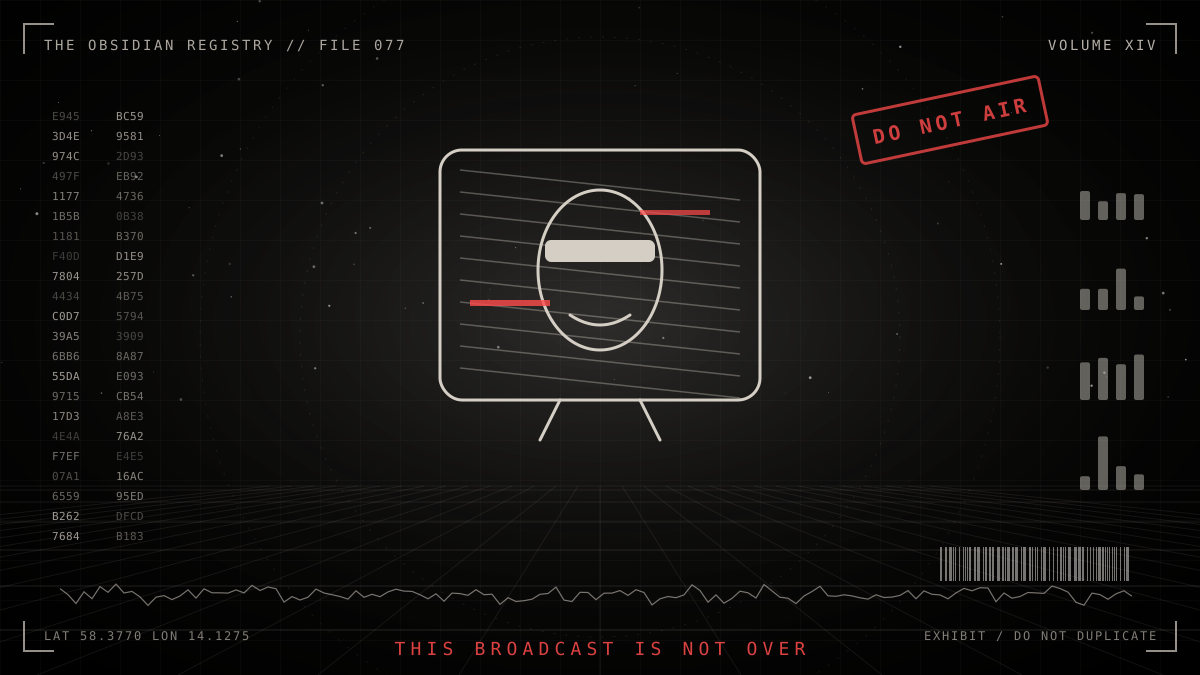 Nobody Caught the Max Headroom Hijacker. We Found His Third Tape.The same masked broadcast, and a third tape nobody has seen, in the sealed file.
Original fiction built on real, cited records. This case page is fact; the files are stories.
Also connected: File 080: This Station Has Buzzed for 40 Years. Last Year It Said a Name.
Connected cases
Case alerts
Get the next unsolved case first
One email when a new case or file opens. Plus File 027 free in full. No spam, one click to leave.
Real cases are only half of it
The Archive keeps the other half sealed.
Every file in the Archive starts the same way this page does: a real record, real sources. Then it keeps going where the record stops. The first pages of every file are free.