
TRUE CRIME · CASE 53 OF 60 · UNEXPLAINED DEATHS · NO FICTION ON THIS PAGE
A Dead Man on the Beach, a Secret Pocket, and a Code Nobody Can Read. The Somerton Man.
The Somerton Man, "Tamám Shud" (Adelaide, 1948)
Quick answer
Who was the Somerton Man?
On December 1, 1948, a well-dressed man was found dead on Somerton Park beach near Adelaide, Australia. Every label had been cut from his clothes. Hidden in a secret pocket was a scrap of paper torn from a book of poetry, reading "Tamám Shud": it is finished. The book later turned up with a phone number and a code nobody has ever read. In 2022, researchers said DNA finally gave him a name. Police have not confirmed it, and how he died is still unknown.
Has the Somerton Man case been solved?
Cause of death never established. The code has never been read.
When and where did the Somerton Man case happen?
About 6:30 a.m., December 1, 1948, against the seawall at Somerton Park beach. Near Glenelg, Adelaide, South Australia.
Inside this case (8 parts)
The Obsidian RegistryPublic recordCase 53
The Somerton Man, "Tamám Shud"
The Somerton Man, "Tamám Shud" (Adelaide, 1948)
At 6:30 in the morning on December 1, 1948, a couple walking on Somerton Park beach, near Adelaide in South Australia, found a man lying against the seawall.
He was neatly dressed: a jacket, a tie, polished shoes. His legs were stretched out and crossed at the ankles. A half-smoked cigarette had fallen onto his collar.
He was dead.
He had no wallet and no identification. Every label had been cut out of his clothes.
More than seventy years later, his case is still known by two words found in a hidden pocket: "Tamám Shud."
The man on the beach
The man looked to be about 40 to 45 years old. He was around 180 centimeters tall, in very good physical condition, with grey eyes and fair to ginger hair. His hands showed no sign of manual labor.
His clothes were good quality. Police noted that his jacket appeared to have been made in America, which was unusual in Australia at the time.
In his pockets were an unused train ticket, a bus ticket, a narrow comb, a half-empty packet of chewing gum, a packet of cigarettes of one brand containing cigarettes of another, and a box of matches.
Some people said they had seen a man lying in the same spot the evening before, moving his arm. Nobody thought anything of it.
The autopsy
The pathologist found signs of congestion in the brain, stomach, liver and spleen. His last meal was a pasty, eaten a few hours before death.
The pathologist believed the death was not natural, and suspected poison. But tests found no poison in his body.
That was not as strange as it sounds. In 1948, some poisons broke down quickly and left almost no trace. A later review suggested digitalis, a heart drug that can be fatal in large doses.
The coroner said he was prepared to find that the man died of poison, but he could not say what poison, whether it was given to him, or whether he took it himself.
The suitcase
On January 14, 1949, staff at Adelaide railway station found a brown suitcase that had been checked into the cloakroom on November 30, the day before the body was found. Its label had been removed.
Inside were clothes, many with their labels cut out, as on the dead man's clothes. There was a red dressing gown, slippers, pyjamas and shaving gear.
There were also unusual items: a stencilling brush of a kind used by third officers on cargo ships, a table knife cut down into a short blade, scissors, a screwdriver, and a reel of orange waxed thread that matched a repair in the dead man's trousers.
A few items still carried names, "Kean" and "Keane." Police checked. They led nowhere.
Tamám Shud
In June 1949, while re-examining the clothes, a pathologist found a tiny pocket sewn inside the waistband of the man's trousers.
Rolled up inside was a small scrap of paper with two printed words: "Tamám Shud."
The words are Persian. They mean "ended" or "it is finished." They are the last words of a famous book of poetry, the Rubaiyat of Omar Khayyam, which is about living fully because life is short.
The scrap had been torn from the last page of a copy of the book.
Police asked the public for help finding it.
The book and the code
In July 1949, a man came forward. He said he had found a copy of the Rubaiyat thrown into the back seat of his unlocked car, parked near the beach, around the time the body was found.
The last page was torn. The torn edge matched the scrap.
On the inside back cover were faint indentations of five lines of capital letters, as if someone had written them on a sheet of paper resting on the book. The second line was crossed out.
Nobody has ever decoded them. Experts in Australian military intelligence looked at the letters in 1978 and said there were too few of them to solve with confidence. Later researchers suggested they might be the first letters of words in a sentence, but nobody has found the sentence.
Also on the back cover was a phone number.
The phone number
The number belonged to a nurse who lived about 400 meters from where the body was found.
When police showed her a plaster cast of the dead man's head and shoulders, she reportedly seemed shocked. She said she did not know him.
She said she had once given a copy of the Rubaiyat to an army officer she knew during the war. Police found him alive in Sydney, with his copy of the book still complete.
She asked police to keep her name out of the newspapers. Her family later said in a 2013 television interview that they believed she knew more than she said.
She died in 2007. Because she was never a suspect, she is not named here.
A name, at last?
The man was buried in Adelaide in 1949, under a headstone that described him as unknown.
For years, a researcher at the University of Adelaide, Professor Derek Abbott, argued that DNA could solve the case. In May 2021, after approval from the state government, the body was exhumed.
In July 2022, Abbott and genetic genealogist Colleen Fitzpatrick announced that they had identified him. Using DNA from hairs caught in the plaster cast made in 1949, they traced his family tree to a man named Carl "Charles" Webb, an electrical engineer and instrument maker born in Melbourne in 1905.
Webb had separated from his wife and moved out in 1947, the year before the body was found.
South Australia Police said they were cautiously optimistic about the finding but have not formally confirmed it. The state's forensic science agency has not released results from the exhumed remains.
What we still don't know
If he was Carl Webb, why was he in Adelaide, so far from Melbourne, with every label cut from his clothes?
How did he die? Poison is the most widely accepted explanation, but which poison, and whether he took it himself, has never been established.
What do the five lines of letters in the book say?
And why did he carry those two words, "Tamám Shud," sewn into a hidden pocket, as if he already knew?
Sources
- Somerton Man (Wikipedia)
- Smithsonian Magazine: Have scholars finally identified the Somerton Man? (2022)
Everything on this page comes from the public record above. Where sources disagree, we say so. People who were never charged are not named.
Read next · from the sealed Archive
If this case stays with you, open File 090
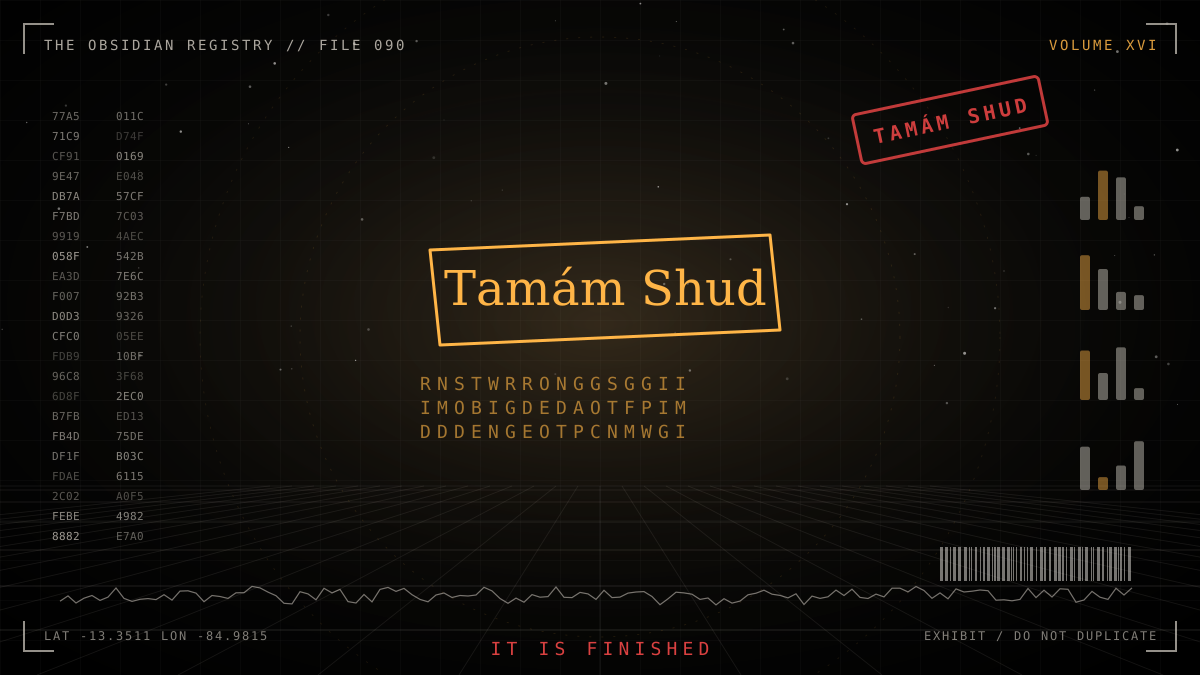 Tamám Shud: Never Read His Code Out LoudThe same man on the beach and the same unread code: Tamám Shud, in the sealed file.
Original fiction built on real, cited records. This case page is fact; the files are stories.
Also connected: File 089: She Had Eight Fake Names. The Ninth Is Yours.
Connected cases
The real records: How codebreakers work: declassified cryptology
Case alerts
Get the next unsolved case first
One email when a new case or file opens. Plus File 027 free in full. No spam, one click to leave.
Real cases are only half of it
The Archive keeps the other half sealed.
Every file in the Archive starts the same way this page does: a real record, real sources. Then it keeps going where the record stops. The first pages of every file are free.